 The American College of Greece


MBA with Tourism Management
At Alba Graduate Business School
-
 Duration: 28 months part-time
 -
 Next start date: November 9, 2026
 -
 100% online
 -
 Fees: €9.950
AMBA
accredited
60%
of alumni in senior roles

Flexible study mode
Get further information on your program
Fill out the fields below to talk to us about studying with Alba.
Alba Graduate Business School, The American College of Greece, will use the details submitted on this form to contact you by phone and email, to understand your individual situation and requirements and to provide you with tailored information about our online programs. The data provided will be processed on the basis of the consent provided here. Calls may be recorded for training purposes. For further information on how your data may be used, please read the our full Privacy Policy. You can alter your preferences at any time by emailing [email protected]
Our accreditations and memberships
NECHE accredited, AMBA accredited and member of the AACSB.



Take your career to the next level
The program is designed to shape the holistic managerial profile of its participants as future leaders.
For this purpose, students will build their managerial competences through eight core business courses, two concentration courses, one course on Business Methods and a final Business Project course, in which they shall apply and practice their interest in a specified area of concentration.
What you'll learn
Core MBA courses will sharpen your business acumen and develop all-round knowledge on business best practices to enable you to progress in your career.
-
Gain the knowledge, skills, and stimuli for discovering and solving problems in organizations
-
Specialize in digital marketing and tourism management
-
Delve deeper into a business problem of your choosing on the final project
How you'll learn
This MBA with Tourism Management program is taught through an innovative online learning platform which has been tailored to ensure you get the most out of your studies. It can be accessed on a number of devices, from anywhere, and at any time, making the program flexible around your current commitments.
AI is integrated throughout the online learning experience, helping you personalize and contextualize course materials, explore its application across different business disciplines, and critically evaluate AI-generated outputs. The program emphasizes practical application, responsible use, and the informed human judgement required in today’s business environment.
The program features an unparalleled academic curriculum and online pedagogy that is dynamic and adaptive to online students’ learning needs.
Predominantly delivered asynchronously (80%), the program cultivates autonomous learning skills and offers the convenience and flexibility required by modern professionals. It also embeds in its courses a unique action learning approach by offering 3 live synchronous sessions (20%) that augment your cognitive and empirical achievements. Being integral to your learning journey the live virtual sessions are compulsory and are scheduled every other Saturday, during each 8-week-long course. Each session last for 3 hours and is hosted by Alba’s renowned faculty that teach on your course; they include case discussions, simulations, group work, role playing, and presentations.
Courses
This concentration combines tourism management with digital marketing, helping students understand destination ecosystems, sustainable tourism practices, evolving traveler behavior, and data-driven marketing strategies.
It prepares professionals to respond to change, manage complexity, and create value in a highly competitive and fast-moving sector.
From the smaller business to the larger organization in the global economy, companies depend on the motivation and behavior of people with diverse backgrounds and cultural values that have to work together effectively and efficiently. It is the role of managers to plan, organize, direct and control an organization’s resources in the manner most effective for it to achieve human, organizational and social objectives in a changing environment. The specific objectives are to develop an awareness of the knowledge and skills that underlie leadership effectiveness while establishing the foundational knowledge about leadership styles, leadership processes, and leadership contexts.
As a business person, have you ever wondered “The products/ services I offer are great, but why don’t customers prefer them?” As a consumer, have you ever wondered “Why on earth did I buy this product”? If so, you are at the right place to find answers. This course is an introduction to the basic marketing concepts. Its purpose is to familiarize you with strategic (segmentation, targeting, and positioning) and tactical (the Marketing Mix) marketing analysis and implementation, and the two key tools that aid marketing decision making (Marketing Research, and Consumer Analysis). It also discusses the emerging issue of social responsibility that customers increasingly require from brands.
This course concentrates on the economic foundations of management by developing tools to analyze key issues of the industry (microeconomics) and general economic environment (macroeconomics) of a company. The first part, microeconomics, analyzes consumer behavior, producer pricing and production decisions under different market structures. The second part, macroeconomics, studies the operation of the entire economy, analyzing topics such as the determination of aggregate output, employment, inflation, interest rates, exchange rates and other macro variables.
This course introduces students to predictive and prescriptive analytics using tools of decision sciences and statistics. Participants will learn to select key information from a problem formulation, develop mathematical/statistical models, and assess goodness of their solution using Microsoft Excel. Topics covered include forecasting, decision analysis, and business optimization. It is a practical course that uses real world examples to illustrate how to apply quantitative techniques to draw useful managerial insight.
The course seeks to provide students with a broad introduction to the need for external accounting systems, the principles explicit and implicit within such systems, and the strengths and weaknesses in such systems. The course discusses the concepts and tools needed to understand and apply accounting information in optimizing managerial decisions, corporate planning and control. It focuses on the application of cost management, pricing, customer profitability analysis, budgeting, amongst others, for effective decision making. Key concepts and methods of accounting are discussed by focusing on the reporting of the financial position and financial performance of business organisations, the analysis of the financial statements produced by business organisations and the use of accounting information by management for planning, decision making and control purposes.
This course provides a well-balanced understanding of the underlying theory and its most important practical applications that allows managers to take financial decisions regarding the operating, investing, and financing activities of the firm. The course begins with an introduction of the financial landscape. It then examines how corporations create value through capital allocation. Specifically, it focuses on capital budgeting, valuation analysis and financing. Particular emphasis is placed upon the understanding of analytical techniques that provide numerical input to the decision-making process. Finally, the course discusses some key financial functions of MS Excel.
Production and Operations management can be defined broadly as the process steps that fulfil the production and delivery of “goods”, where “goods” include both material products and intangible services that offer some utility to the end consumer and the overall process subsumes all stages required to transform a product from a rough idea in a brainstorming meeting to the end customer offering. This course focuses on managerial decisions in production and operations and their interrelationships with the other functional areas of the firm. Major areas of study include the design of productive systems, strategic planning, and operations planning and control. Specific topics cover the areas of process and job design, facility planning, capacity planning, distribution planning, inventory management and production planning and control.
As the internal and the external environment of firms are in constant flux, managers need to sharpen their strategic skills. Strategy is the set of objectives and policies that set to define how a firm positions itself to gain competitive advantage and increase returns for its owner and stakeholders. Two questions are of importance, then: “What business should we participate in” and “How should we compete?” In answering these questions, the external environment and the internal firm resources and capabilities take a central role. We also examine strategic choices at the business unit, corporate, and network level. Finally, the course examines strategies in different industries and contexts (mature, new economy, global). Through case studies and assignments, you will learn to use tools for analyzing, creating, and communicating strategies.
Firms nowadays are presented with complex problems which require strong systems and design thinking skills and competences. Moreover, the speed of contemporary business transformations dictates a more active role of the workforce towards enabling and co-creating firms’ future. In this environment, employees strive for the skills but also the tools to inquire complex problems and design organisationally desirable solutions. The current course comprises a unique introduction to business inquiry methodologies that would allow our students to prepare and take active role in solving business problems and devising future opportunities.
You will also choose two of the following
From the MBA with Tourism Management:
This course provides a high-level strategic immersion into the global tourism and hospitality ecosystem, moving beyond basic operations to focus on the complexities of international leadership. Students will examine the intricate interdependencies between transport networks, accommodation sectors, and destination management organizations, learning to navigate the socio-economic and environmental forces that shape the industry. By integrating core MBA disciplines—such as data-driven decision making and organizational behavior—with tourism-specific challenges, the curriculum empowers future executives to architect resilient business models. Special emphasis is placed on the shift toward regenerative tourism, ensuring that students can lead organizations that prioritize long-term sustainability and ethical community engagement alongside profitability. Through the analysis of global case studies and market volatility, students develop the agility required to manage crises and capitalize on shifting travel trends in a hyper-competitive market.
This course offers a comprehensive immersion into the digital marketing landscape as it applies to one of the world’s most tech-sensitive industries. Moving beyond introductory concepts, students engage with the full complexity of modern digital ecosystems — examining how evolving traveler behavior, platform proliferation, and data-driven strategy are fundamentally reshaping how hospitality and tourism businesses compete and grow. By integrating core digital marketing disciplines with industry-specific realities, the curriculum equips future professionals to build and execute strategies that are both analytically rigorous and commercially impactful.
Structured across four thematic chapters — Digital Marketing Foundations, Customer Journey & Strategy Development, Social Media Strategy & Campaigns, and Emerging Trends & Mobile Marketing — the course bridges theory and practice through rich case studies, real-world scenarios, and hands-on workshops. Each module culminates in a practical deliverable, ensuring that students not only absorb frameworks but develop the capacity to apply them under real conditions. Special emphasis is placed on cultivating an objective-oriented mindset: one that remains adaptive and structured in the face of constant platform evolution and market disruption.
Business Project
The course employs a rich curriculum and a gamification approach to learning about sustainability issues, using an interactive and immersive teaching tool in the form of a simulation game. Students will have the opportunity to play the game in groups in several weeks, engage in meaningful discussions and apply skills and strategies they have already developed throughout their MBA studies, which will contribute to long-term success in an ever-changing, dynamic business environment. While playing the game, students will have the opportunity to explore a range of topics, designed to empower them with essential tools and insights for their continuous professional development to be able to lead a sustainable business and address current organisational challenges they may face. Interactive and collaborative learning will allow to reflect on ideas and experiences and contribute to a rich collective experience for all.
Students who obtain all 36 credits from the 12 courses, will receive the MBA degree from Alba Graduate Business School.
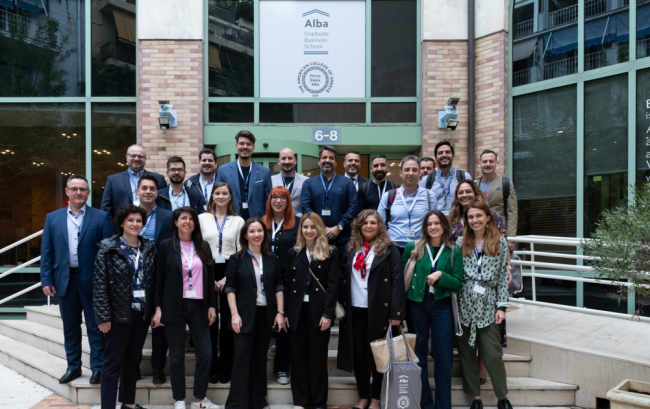
Student profile
This MBA with Tourism Management program is suited to working mid-level professionals who are looking for flexible self-paced study time supported by mainly asynchronous micro-lectures with multiple start opportunities, have already been building their career and are looking for the opportunity to progress into leadership roles.
Online students are more likely to come from international locations with diverse and multicultural backgrounds, aiming to improve their global business network and enhance their knowledge of global management practices.
CLASS PROFILE
Average age: 36 | Average years of experience: 12
Male: 54% | Female: 46%
International participants: 29% | Countries: Australia, Austria, Bahamas, Belgium, Canada, China, Congo Rep. Dem., Czech Republic, Denmark, Germany, Greece, India, Ireland, Israel, Italy, Korea, Kuwait, Lebanon, Luxembourg, Nigeria, Oman, Poland, Qatar, Serbia, Slovakia, Switzerland, The Netherlands, United Kingdom, USA
Top Industries: Information Technology, Manufacturing, Banking, Energy, Media, Retail & Consumer Goods, Transportation & Shipping, Travel & Hospitality
Top Functions: General Management, Product Development, Project Management, Finance, Marketing, Software Engineering, Business Development, Founder
Potential career paths
This MBA prepares professionals to lead in a tourism and hospitality industry transformed by digital platforms, changing traveler expectations, sustainability imperatives, and market volatility. Graduates will be equipped to design resilient strategies, understand destination ecosystems, apply digital marketing insight, and create value for businesses, communities, and travelers.
Developing you into:

Managers in a range of departments
Tourism and Hospitality Managers
Creative team players
Mindful business leaders
Admission requirements
To study for this program, you must:
- Hold a bachelor’s degree.
- Have a minimum of three years of work experience, acquired post-graduation.
- Provide a CV with contacts to two references.
- English language proficiency.
- Answer three short essays.
Technical requirements:
Student Computer Requirements (all of them must be met)
- A computer device that is up to 6 years old and has an updated OS
- Portable web camera OR built-in laptop camera
- Microphone headset OR built-in computer/laptop microphone
- Minimum Internet connection speed of 0.400 Mbps (0.900 Mbps is optimal)
- Minimum recommended RAM of 4GB (free RAM of 2GBs)
- Minimum recommended free disk space of 250GBs
- Download and install an Internet Browser (Microsoft Edge or Google Chrome).
To learn more about academic regulations and student conduct at Alba, you can download the Student Handbook and the Student Code of Conduct.
Start dates
We have five (5) start dates a year, so if you choose to study the Alba MBA you could begin within weeks.
APPLY NOW
November 9, 2026
Next start date October 23, 2026
Application deadlineAlba online teaching
We have a tailored, AI-enhanced, learning environment to help you get the most from your online studies with Alba, ACG.

Learn at a time that suits you
Support from enrollment to graduation from a dedicated Student Success Coordinator
Study alongside peers from around the world
Taught by Alba Faculty

AFFORDABLE

APPLY TO YOUR
CURRENT ROLE

FLEXIBILITY

NETWORKING

ONLINE PRACTICE

LEARNING BY DOING